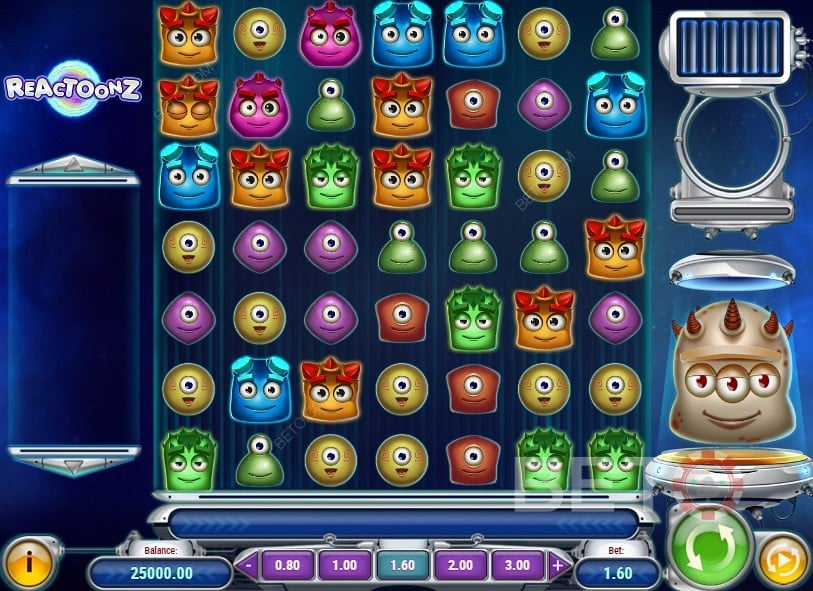
On TK999, the Reactoonz Slot is one of the most talked about TK999 slots for Bangladesh players who like fast visuals and feature driven swings. This review stays strictly on gameplay mechanics and content. It explains how cluster wins form, how symbols behave inside combinations, and how the feature meter upgrades the grid over time. Everything is described from what appears on screen, from cascades to special effects, so the reader can see why Reactoonz feels closer to a puzzle board than a classic reel slot.
Reactoonz uses a 7 by 7 grid and a cluster pays engine. A win appears when five or more matching icons connect anywhere on the grid, including diagonal connections, and the winning cluster disappears before new symbols drop in. That drop can trigger cascades, so the same spin may rebuild the board several times. Low tier icons land often and build steady clusters, higher tier icons land less often and benefit when large color zones develop, and a wild symbol substitutes to complete a group. A scatter symbol supports feature progression, pushing the meter toward upgrades that can reshape the grid.
Core parameters table for Reactoonz Slot:
| Parameter | Reactoonz detail |
|---|---|
| Studio | NetEnt |
| Layout | 7 by 7 grid |
| Win method | Cluster pays, 5 or more connected |
| Reels | No traditional reels or paylines |
| RTP | 96.51% |
| Volatility | High |
| Feature set | Symbol modifiers, Gargantoon, Quantum Leap |
| Top outcome | Up to 4750 times the spin value |
That core table shows why Reactoonz Slot feels so different from a classic reel game: the 7 by 7 grid and cluster pays rule reward board momentum, not fixed lines, while the high volatility profile keeps the biggest swings tied to feature timing. With Symbol modifiers shaping the grid, Gargantoon expanding potential connections, and Quantum Leap pushing the action with extra wild power, the gameplay stays visually busy but mechanically consistent from spin to spin. On TK999, Reactoonz works best as a feature focused slot where understanding how clusters form and how upgrades change the board helps the player follow every chain, every collapse, and every sudden turn in pace.
The feature system is the headline mechanic in Reactoonz 2026. Scatters advance a meter, and at milestones the game unlocks effects that can trigger during normal play without leaving the main grid. These effects can move symbols, convert them into a different type, or introduce extra wild links, which is why a calm board can turn into a fast chain mid cascade. Gargantoon expands across nearby spaces to grow potential clusters, while Quantum Leap converts selected symbols into wilds and accelerates connections.
To keep the mechanics easy to follow, the next section defines the symbol roles that matter during cluster checks and cascades. The goal is to show what each symbol type actually does on the grid, before moving to the upgrade layer that changes board behavior as the meter progresses. Here is a breakdown of the core symbol types:
After the symbol roles are clear, it becomes easier to understand why Reactoonz can switch pace so suddenly. The upgrade layer is not a separate mode - it is a set of effects that can appear on the same 7 by 7 grid and reshape how clusters form, which is why a normal cascade can escalate into a longer chain:
Once upgrades start appearing, board state becomes more important than single icons. A modifier can set up the next drop, and the next drop can keep one color dominant long enough to build larger clusters. Gargantoon can turn a medium cluster into a large one without perfect alignment, and Quantum Leap can turn near misses into completed groups by adding extra wild links. The result is controlled chaos: patterns form, break, and reform quickly, but the logic stays readable because clusters always follow the same connection rule.
Reactoonz is easy to learn in demo and free play modes because the core rule never changes: clusters of five or more connected symbols pay, then disappear, and the grid refills. What makes free play especially useful is that it lets the player read the game as a living board rather than a set of reels, so cause and effect stays visible from drop to drop.
Inside the TK999 slots lobby, the player can treat free play as a mechanics walkthrough. It becomes simple to notice when one color starts to dominate the 7 by 7 grid, when wilds land in positions that bridge gaps, and when the feature meter is close to an upgrade that can reshape the next cascade.
The table below highlights the most practical things to watch during free play, with a direct link between what happens on screen and why it matters for reading Reactoonz:
| What to watch | What it looks like on the grid | Why it matters |
|---|---|---|
| Cluster density | One color spreads across multiple zones | Larger connected shapes become more likely after a refill |
| Wild placement | Wilds land near two partial groups | A single wild can merge gaps and extend a chain |
| Cascade rhythm | Several drops in a row keep feeding similar symbols | Long cascades often build momentum that upgrades can amplify |
| Scatter timing | Scatters appear close together across spins | The meter advances faster and upgrades arrive sooner |
| Upgrade impact | Symbols shift or convert without leaving the grid | Board logic changes mid flow, creating new connections |
After the player understands these signals, free play becomes less about watching random icons and more about tracking board state and timing, which is the real language of Reactoonz.
The checklist below makes the free play session easier to follow without overthinking it, especially when upgrades start triggering in quick succession:
Used this way, Reactoonz free play on TK999 casino site works like a practical tutorial: simple cluster rules, fast cascades, and an upgrade system that can flip the pace from steady to explosive while keeping the same connection logic on every spin.
Yes. The cluster rule stays the same, but the board can behave very differently depending on how often the feature meter reaches new milestones. When Symbol modifiers start firing, the grid stops being passive and becomes reactive, so a normal cascade can suddenly turn into a longer chain because symbols shift or convert mid flow.
No. Reactoonz uses a 7 by 7 grid with cluster pays, so wins come from five or more connected symbols anywhere on the board.
Gargantoon is a growth mechanic. It expands into nearby spaces and can increase the size of potential clusters without needing perfect drop alignment. Its real value is that it can turn a medium connection into a larger connected shape after it lands, which can also set up the next refill for more cascades.
Look for these quick signals on the grid, then follow the next refill to confirm it:
When two or more signals appear together, Reactoonz often shifts from single hit behavior into a cascade sequence, especially if an upgrade triggers during the chain.
No, but it changes connectivity. Quantum Leap converts selected symbols into wilds, so near misses become completed clusters more often. The rule is still five or more connected icons, yet the board can connect faster and stay active longer because wild conversions reduce the number of exact matching symbols needed for the next cluster.